

Instead of hurrying home after the school run I had another mission. At the top of my very long to-do list was a pilgrimage to visit the lilacs.
Withdean park houses the second largest collections of lilacs in the world with around 200 different varieties. Next to one of the main roads into Brighton & Hove, I had driven past the lilacs for years, never stopping. The park was largely empty except for dog walkers and me. The hum of the insects mingled with the distant sound of cars on the motorway. Spread in clusters at the edges of the cut grass lawn where lilac bushes. They had large cones of blooming petals in hues of white, violets, blues, magenta’s, pastel pinks, and even palest primrose. The smell was incredible: heady and syrupy sweet.
The detour took a little over an hour and then I was back home working. Rather than taking anything away from my day I felt like I accomplished more. When I finished work, instead of feeling exhausted I felt replenished. This was one of my first attempts at consciously practicing the Japanese principle of yutori.

Yutori: the art of creating a spacious life
“Yutori (ゆとり) is a Japanese concept that translates to ‘spaciousness,’ ‘leeway,’ or ‘room to breathe’. It’s more than just physical space; it encompasses mental, emotional, and temporal room, encouraging a more balanced and less stressful way of living. Nihongo Master translates yutori as ‘elbowroom; leeway; room; reserve; margin; allowance; latitude; time’”
I am somebody who desperately needs more yutori in my life.
I do want to acknowledge that for some people yutori is easier to achieve than for others. I am aware that I have financial privilege and a relatively flexible schedule. There were times in my life: when I was working three jobs, when I had a newborn and a toddler, when my mother was seriously ill: where yutori would have been almost impossible. If this is the season you are currently in, extend yourself kindness. We do not all have the same 24 hours. Some of us are more able to make time available in our schedule than others.

Yutori: the antidote to toxic productivity
Yutori is a counterpoint to our culture of toxic productivity. This compulsion to be constantly achieving and busy does not stop at work but extends to our leisure time too. This can lead to shame around rest, an inability to switch off and in the end: burnout.
Oliver Burkeman’s amazing book Four Thousand Weeks: Time Management for Mortals talks about this existential dilemma better than I ever can.
“Productivity is a trap. Becoming more efficient just makes you more rushed, and trying to clear the decks simply makes them fill up again faster. Nobody in the history of humanity has ever achieved “work-life balance,” whatever that might be, and you certainly won’t get there by copying the “six things successful people do before 7:00 a.m.” The day will never arrive when you finally have everything under control—when the flood of emails has been contained; when your to-do lists have stopped getting longer; when you’re meeting all your obligations at work and in your home life; when nobody’s angry with you for missing a deadline or dropping the ball; and when the fully optimized person you’ve become can turn, at long last, to the things life is really supposed to be about. Let’s start by admitting defeat: none of this is ever going to happen. But you know what? That’s excellent news.”
― Oliver Burkeman, Four Thousand Weeks: Time Management for Mortals
All of which was all too familiar to me, somebody who had always valued myself on what I do rather than who I am. I was constantly rushing through life rather than experiencing it. I had become a human doing rather than a human being. And in this process, I had lost sight of what truly mattered. I was getting stuff done but missing the things in life which give it colour and meaning.
Often rushing behaviour is learnt in childhood. In Transactional Analysis, different aspects of our personality are called drivers. Drivers are early personality adaptations that help us get our needs met as children. One of mine is the Hurry up driver. People who have a Hurry up driver are constantly rushing and find it extremely difficult to stop. When we are in our driver, we tell ourselves – ‘I am okay because I am getting lots of things done’. Rushing performs a function, it stops our ability to feel or think clearly. Stuff may get done but often it is rushed and sloppy because we jump from task to task. People with this driver feel tired and unable to relax.
To counteract this we must recognise that we are not machines built merely to produce, we are animals. And animals need rest, fuel and space in between tasks. Our to do list will always multiply, there will always be more to do than we could ever accomplish. In Oliver Burkeman’s great book Meditations on Mortality, he talks about how obsessive productivity is a way to mitigate our anxiety about death and our finite lives. The answer, isn’t to double down and do more but to accept this. To incorporate more yutori into my daily life, I came up with a plan.
5 ways I intentionally practise yutori
- Slow down. Because rushing has become a habitual behaviour, I will often notice I am speeding up when there is no need. I use taking a drink of water as a yutori ritual and a waypoint throughout my day to slow down. Every time I drink water, which I must do 10-15 times a day. I try to pause and feel the texture of the cold glass underneath my fingertips. To sense the taste and temperature of the water as it slips down my throat. By going slowly I am soothing my nervous system telling it: I am safe now. I can take my time. There is no need to rush.
- Build a buffer. Because I hated ‘wasting time’ when I had appointments I would often try to arrive exactly on time. But there would be traffic or it would take more time to leave the house than I expected. And I would be late which I found immensely stressful. Now I deliberately build in some cushion time. If I bump into a friend, I have time to chat. If I want to look at something I find interesting, I have time to do so. If the journey takes longer than expected, I have time for that. I want a schedule that has room to breathe.
- Under commit. I have a tendency to over commit and over estimate my capacity. I often try to do too much with the kids because I don’t want them to feel deprived. But it is too much for my nervous system to handle and then I turn into shouty mummy. (And nobody likes shouty mummy.) Even when a day is filled with enjoyable tasks, if they are all crammed together it becomes not enjoyable. So I am getting into the habit of giving myself time to think before making any commitments. I will often sanity check events with my husband as he is more realistic and able to see what is actually achievable. I want to accept that I am human and can only do so much.
- Schedule joy. Listen as a Virgo and a perimenopausal woman, I love a to do list. If I don’t write it down, I won’t remember it and it won’t get done. But I began to notice that I was fulfilling my external obligations to others but not my internal obligations to myself. I needed to start scheduling joy. I have started writing down: walks, breath exercises, tiny but enjoyable side quests. Because yes filing my tax return is important. But so is taking my nine year old sea glass hunting. Buying new toilet rolls is just as essential as watching the murmurations of the starlings. I want a life that holds space for both.
- Be childlike again. One of my children is sloth-like in his speed and does not like to be rushed. Watching him eat is a geological process. Repeatedly I have to regulate myself and remind myself that although there are times I need to rush him (hai external agony that is the school run). Often I don’t, what does it matter if we take 20 minutes to walk to the shops because he was looking at bugs instead of 5. Instead of fighting to hurry him up, it is often more enjoyable to allow myself to drop to his speed. He is a great reminder that I can afford to take my time. What am I rushing for anyway?
I want to build a spacious life. Where there is time to take the scenic route. To go on enjoyable little side quests. To lie in the grass watching the cloud’s shifting shapes above me. Like Tolkien said, ‘not all who wander are lost.’
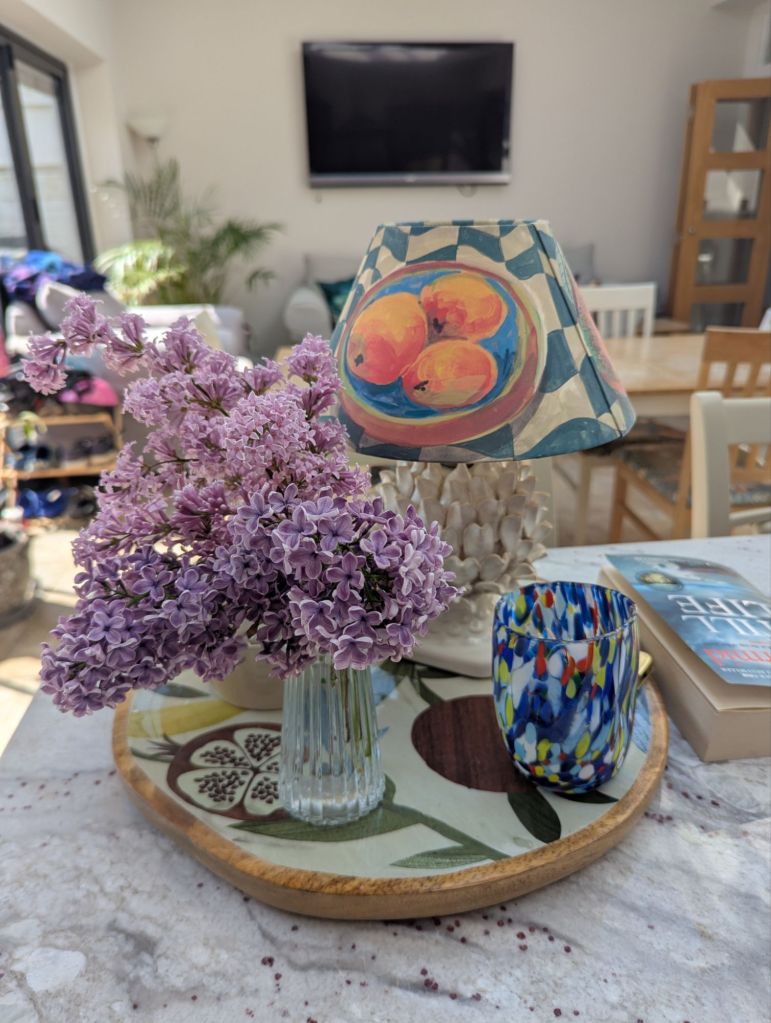
Yes, there will be times when I am too busy to spend an hour wandering through the park looking at lilacs. But today, in this moment, I have the time and I will take it. A vase of lilacs sits on my kitchen counter filling the room with their heady fragrance. A visual reminder to gift myself with yutori.
If you are based in Brighton & Hove area and interested in taking your own pilgrimage to visit the lilacs, Withdean Park is located here. The Friends of Withdean Park helpfully have a map of the lilacs and a trail you can do.
Have you heard of yutori before? Is it allowing yourself spaciousness and room to breathe something you would like to try in your own life?












 Rowan January